cricket 30 Jun 2026 6 min read
India's Ireland Wake-Up Call: What Went Wrong in Belfast, and What Changes in England
Two defeats. One reigning T20 World Champion side. A 15 year old who never got off the bench. And a story that says less about India than everyone's…
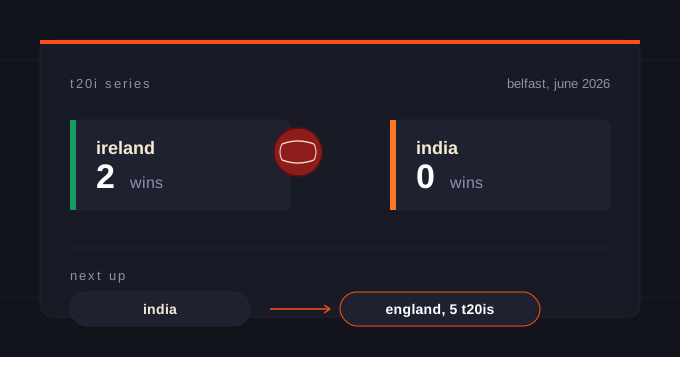
Two defeats. One reigning T20 World Champion side. A 15-year-old who never got off the bench. And a story that says less about India than everyone’s making it out to.
India’s T20 champions arrived in Belfast fresh off an IPL that had barely cooled down, and left having lost their first bilateral T20I series in three years. The overreaction machine is already running — panic on one side, excuse-making on the other. Neither is the right response. Here’s what actually happened, what it means, and what to watch for when the series shifts to England on July 1.
The 2-minute catch-up: what happened in Belfast
1st T20I (June 26): Ireland 182/9 beat India 148 — a 34-run win, Ireland’s first-ever victory over India in international cricket after eight previous attempts.
2nd T20I (June 28): Ireland 154/8 beat India 153/9 — by a single run, sealing a 2-0 series sweep.
That’s a whitewash, and it ended a run of 16 consecutive T20I series without a loss for India — a streak that had stood for close to three years. It’s also India’s first bilateral T20I series defeat since losing 3-2 to West Indies in 2023.
The numbers behind it:
- Jai Moondra, an Indian-born Ireland debutant, took 5 wickets across the two games and won Player of the Series — including the top three Indian wickets in the series-deciding chase.
- Harry Tector anchored both Ireland innings, top-scoring with 53 in the decider.
- Vaibhav Sooryavanshi, the 15-year-old batting sensation India carried into the tour, didn’t play a single match.
- Shreyas Iyer’s first assignment as full-time T20I captain ended in a series loss.
- Ireland pulled this off missing five first-choice players and with a weakened bowling attack — against a full-strength, world champion top order.
Ireland are ranked 11th in the world. That’s not a mismatch story anymore.
What actually went wrong
It’s tempting to reach for one excuse. The real answer is layered, and it’s worth being honest about all of it rather than picking the convenient one.
1. Conditions, not just fatigue. Belfast offered seam, swing, and bigger boundaries — the opposite of the flat, boundary-friendly IPL surfaces this Indian squad had spent two months on. Ireland’s pace attack, built for these conditions, exploited it. India’s batters, tuned for T20 power-hitting on shorter grounds, didn’t adjust quickly enough. That’s a skill gap in adapting, not just bad luck.
2. The IPL turnaround was real — but it was always going to be. Players went from an IPL straight into a different format of pressure, different opposition, different pitches, with almost no reset time. That’s a legitimate factor. But it was known well in advance. Nobody was surprised by the calendar. If the itinerary was too tight, the conversation needed to happen before the tour was agreed to. You can’t accept the schedule and then use the schedule as the excuse and hope no player or management does people around dont make noise.
3. Is India underestimated the opponent. A full-strength, ICC world champion squad lost to an Irish side missing five first-choice players. That only happens when the gap in application — not talent — closes faster than expected. Belief that “we’ll cruise through Ireland and get to the real series in England” if that is the mindset then it makes upsets like this possible.
4. Personnel calls that didn’t pay off. Leaving Sooryavanshi out of both games, after building him into the squad and the narrative, meant India never found out what he offers in these conditions — and it left a talented middle order short of depth when the top order collapsed twice.
None of this is really about “the better team lost.” Ireland won because they defended totals well below what India would normally chase down comfortably — twice. That’s a performance, not a fluke.
Why Ireland winning is good for the sport
This part shouldn’t be controversial: an Ireland win over the T20 World Champions is exactly what cricket needs more of, not less.
- It proves conditions and disciplined bowling still matter more than raw power-hitting, even in T20.
- It gives Associate cricket a genuine, credible headline — the kind that gets kids picking up a bat who otherwise wouldn’t.
- It’s a result earned without home advantage in depth — Ireland did it short-handed, against a full-strength opponent.
If cricket only ever produces predictable results, it stagnates. Upsets like this are the sport evolving, not breaking.
What to expect in England (July 1–11)
There’s no time to sit with the Belfast result. The five-match T20I series against England starts immediately:
| Match | Date | Venue |
|---|---|---|
| 1st T20I | July 1 | Riverside Ground, Chester-le-Street |
| 2nd T20I | July 4 | Old Trafford, Manchester |
| 3rd T20I | July 7 | Trent Bridge, Nottingham |
| 4th T20I | July 9 | County Ground, Bristol |
| 5th T20I | July 11 | The Rose Bowl, Southampton |
A few things worth watching:
- Different conditions, same test. English pitches in July are generally flatter and more batting-friendly than Belfast, but the new-ball swing at Chester-le-Street and Old Trafford will again ask questions of an Indian top order that’s now lost its last three innings in these conditions.
- A stacked England attack at home. Harry Brook’s side includes Jofra Archer, Adil Rashid, and Jos Buttler — a full-strength unit with nothing to prove and everything to gain against a shaky-looking World Champion side.
- The head-to-head still favours India — 18 wins to England’s 12 across 30 T20Is — and the two sides met as recently as the T20 World Cup 2026 semi-final in March, which India won by 7 runs. History says India are the better side on paper. Belfast says paper doesn’t play the matches.
- Sooryavanshi’s chance. He’s been retained for the England leg. If he gets a game, he has the opportunity to become the youngest Indian to debut in international cricket, overtaking Sachin Tendulkar’s record — and to finally show what he adds against high-pace English bowling.
- Shreyas Iyer needs time A results-based reset — rotating batters up the order, giving the middle order more clarity, and trusting the same top-order approach that won a World Cup in March rather than overcorrecting after two bad days — is more likely to work than wholesale panic changes.
The bigger point
India can’t win every single day, and pretending two close, competitive losses to a well-drilled Irish side are some kind of institutional crisis is an overreaction. But so is waving it away as purely an IPL hangover. Both things are true at once: fatigue and unfamiliar conditions made this harder, and Ireland were the better side across two matches, fair and square.
The Ireland series should be a preparation wake-up call, not a panic button. If the think tank walked into Belfast assuming it was a formality before the “real” series in England, that assumption itself was the mistake — and it’s one worth not repeating against a fully fit England side with a point to prove at home.
Here’s hoping India respond the right way: not with excuses, but with better preparation and adaptability — and here’s hoping Irish cricket gets the credit and attention this week deserves, win or lose from here.
Catching the series live, or just here for the score line? Either way — drop your prediction for the Chester-le-Street opener below.
Get caught up by email
Pick what you want — new posts, or reminders + news for the sports you follow. No spam, unsubscribe in one tap.
Comments